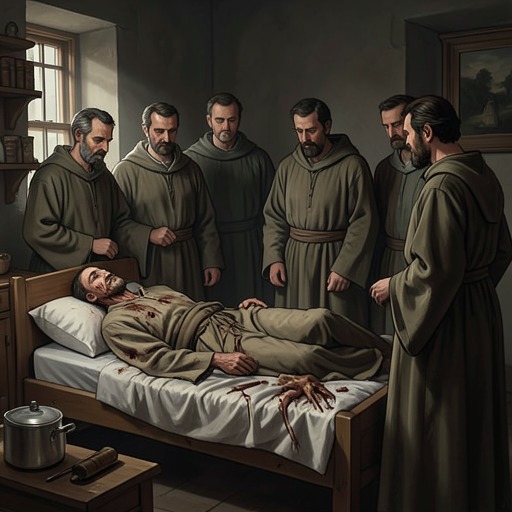
Father Ferapont
The Brothers KaramazovFather Ferapont is an aged monk whose extreme fasting, silence, and solitary habits place him at odds with the monastery’s community and especially with Elder Zossima’s institution of elders. His reputation rests on an uneasy combination: others regard him as crazy, yet that very strangeness attracts them, and his account of seeing Christ in a tree gives his isolation a visionary dimension without resolving whether it should be understood as holiness or delusion.
Identity and Ascetic Life
Father Ferapont lives in the hermitage, but apart from its communal routines. He is at least seventy-five and occupies an old, decaying wooden cell in a corner beyond the apiary. His severe devotions—fasting and keeping silence—mark him as an ascetic, while his separation from the other monks makes his presence feel almost like a distinct religious world within the same institution.
The monastery does not insist that he follow its regulations. His conduct is sufficiently unusual that the monks leave him alone, as though his apparent madness exempts him from ordinary discipline. This accommodation is not simply respect for an established spiritual authority: it also reflects the community’s uncertainty about him. His eccentricity draws people even as it makes them wary.
Opposition to the Elders
Father Ferapont does not visit Elder Zossima. He regards the institution of elders as a pernicious and frivolous innovation, placing his austere, solitary piety in direct contrast with Zossima’s religious authority and the communal form of spiritual guidance associated with it. The disagreement is therefore not only personal. It presents two competing modes of monastic life: withdrawal and strict ascetic practice on one side, and the recognized institution of elder-guidance on the other.
The contrast also shapes how others interpret spiritual experience. A visitor who has recently spent time with Father Ferapont is left puzzled about whom to believe, impressed and overawed by the encounter but confronted with conflicting judgments about the monk. His force of personality unsettles the community’s confidence in a single, settled account of holiness.
Vision of Christ
Father Ferapont describes a tree whose shape changes for him at night. Its two branches become the outstretched arms of Christ, reaching toward him. He says that the sight is clear to him and that it makes him tremble; the experience is terrible as well as sacred. The vision gives concrete form to the tension surrounding him: what others can see as an ordinary tree becomes, in his account, a direct encounter with Christ.
That image does not establish the vision as a miracle, nor does the narrative settle it as mere delusion. Instead, it makes Father Ferapont’s religious difference visible. His asceticism has already separated him from the monastery’s daily life; the nocturnal vision intensifies that separation by placing him in a private relation to the sacred, one that outsiders can hear about but cannot verify. His characterization thus holds severity, spiritual longing, and perceived madness together without making them interchangeable.